197 7th Ave New York, NY 10011212-206-7777
24/7 Emergency Locksmith Services

Door Installation

Advantages of Steel Door Installation

Posted onApril 21, 2022byadmin

When it comes to physical commercial security and sheer strength, there’s almost no better bet than solid steel reinforced doors at your residential or commercial property – especially when paired with solid, Grade 1 ANSI rated deadbolts. In this blog entry, the NYC residential lock installation service experts here at SOS Locksmith will detail the main advantages offered by steel door installation service.

Continue reading →

Useful Commercial Door Upgrades

Posted onApril 21, 2022byadmin

The NYC commercial lock installation experts here at SOS locksmith recommend that all business owners take a proactive approach to analyzing the existing security framework of their business. If any security gaps or lapses are detected, upgrades of security hardware can rapidly increase the level of protection that your commercial property can enjoy. In this blog entry, the professional https://www.soslocksmith.com/locks/ experts here at SOS Locksmith will detail 3 useful and effective ways that you can upgrade your commercial door.

Continue reading →

Why Steel Doors are a Fantastic Investment

Posted onMay 16, 2021byadmin

As doors go, the stronger and more solid the material they’re made of, the more security the door will provide your home or business. There’s almost no better option for door construction than steel doors. In this blog entry, the https://www.soslocksmith.com/doors/ here at SOS Locksmith will explain the main reasons that steel doors are a worthwhile security investment.

Continue reading →

Panic Bars

Posted onDecember 13, 2018byadmin

Panic bars are essential pieces of safety hardware that allows for the easy exit from buildings in the event of an emergency. However, there’s other benefits and uses for panic bars that are little known aside from professionals. In this blog post, the residential and commercial security experts here at S OS Locksmith will provide some details as to the history of and uses for panic bar hardware.

Continue reading →

Choosing the Best Door

Posted onFebruary 23, 2018byadmin

There’s a major variety of door makes and models available on the market today, so large of a variety that it can be difficult for the average consumer to determine what door would work best for their residential or commercial needs. As professional locksmith experts , the team at SOS Locksmiths regularly helps assess each one of our client’s needs, and then recommend a door perfect for them. We’ve prepared this short list of the qualities everyone should be looking for when determining the best doors for their needs – so keep them in mind if you’re door shopping on your own.

Continue reading →

Warm Weather Vehicle Security Tips

Posted onMay 23, 2016byadmin

As the mercury on the dial increases, so does the likelihood of vehicle break-ins. The weather gets warmer, people start leaving their windows open, and thieves can spot their valuables from the street. A cracked window can be seen as an invitation to a thief, and they will often stop at nothing to take items that they spot and desire. Being the victim of these sort of crimes can be seen as frustrating not only because of the trauma and loss involved, but because you know in retrospect that you could have prevented it. This spring and summer, don’t leave yourself vulnerable because of the warm weather. Follow these steps to avoid becoming a victim of vehicle theft:

Put all objects, even one’s that aren’t valuable, in a locked glove box or inside the trunk. Don’t leave them out on the seat, even in a locked car, as a temptation.

Don’t leave out lighters, gas cans, or any heat sensitive items out in the sun, where they could explode and compromise your vehicle’s security, much less harm it’s interior.

Make sure your windows are tinted – not only does it help mitigate the heat, it also makes your car much harder to see into at night.

Look in the rear seat of your car for any people before you get inside it.

Don’t ever leave your keys inside the vehicle, or even hidden under the seat or mat.

When leaving the car, check the back seat for any items a criminal might want – put these in the trunk.

When parking at night, make sure to park under a light where your vehicle will be more secure.

Types of Home Security Systems

Posted onApril 3, 2016byadmin

There’s a wide variety of home security systems currently on the market. Choosing between them to find which one is best for your home can be very daunting. Installing a security system at your home ensures the protection of your family and property – making them an absolute must; however it’s always best to utilize the absolute ideal security system for the needs of you and your family.

Monitored Security System

These alarm systems are commonly used throughout the world, and carry their own list of pros and cons. The system, when triggered, will alert a call center which will then contact your local police. Since this system works through your outside telephone lines, your burglar could potentially disrupt it by locating and cutting your phone lines. Even when tripped the system would be unable to notify the call center, so the police would never be called. One potential for a substitute for a monitored alarm is the use of a cell phone or radio instead of a landline alarm. The other potential drawback to these kinds of alarms is that even when the alarm is set off, it will take some time for the police to arrive – meaning by the time they do get there, the burglar will have had plenty of time to grab valuables and get out of there. Even with these drawbacks, these kinds of alarm systems are some of the most expensive on the market.

Non Monitored Alarm Systems

This other type of alarm system sets of an incredibly loud siren both inside and outside the house when the alarm is tripped. This sort of system relies on healthy contact with your neighbors, so that they will know to call the police when the alarm goes off and you’re not home. One of the best aspects of these systems is the fact that they don’t have monthly fees, meaning that it’s much more affordable than monitored systems. These systems can also be installed with bright flashing lights so people can be more clear on what house the alarm is sounding from. Usually, loud sirens will be enough to make any burglar leave immediately, as there will immediately be a ton of attention focused to the house. Of course, one disadvantage is that you will have to rely on your neighbors vigilance in hearing the alarms and calling the police; if your neighbors are often away, or aren’t likely to hear or call the police, these alarms could potentially not do that much for your home security – especially if you don’t have neighbors and live in the middle of nowhere.

Wireless Alarms

These systems can often be found at regular, local hardware stores. There’s both advantages and disadvantages to these kinds of security systems. One of the chief advantages is that they are quite simple to install and carry no monthly monitoring fees – you can simply decide whatever settings that you prefer; there’s many options including cameras, beams, sensors, or motion detectors. Some of the drawbacks to these systems is the space limit between sensors and cameras, and the need to replace batteries quite often – which can eventually become pretty pricy.

Electric Current Based Alarm Systems

Just like the rest of the types of alarm systems, electric current based home alarms carry their own sets of advantages and disadvantages. These alarms are usually installed in homes during their construction, so they can mostly be found in newer homes. It monitors doors and windows and sounds a beeping noise when they are opened. This is a fantastic feature for both preventing burglaries, but also ensuring that your children aren’t opening doors and windows of your home. Some of the disadvantages of this type of system is that electrical current flows from outside can disrupt your alarm signal and render it incapable of working – for example, lightning can affect these systems and render them inoperational for a period of time.

Common kinds of Door Repairs

Posted onMarch 23, 2016byadmin

Many locksmiths and door repair experts find that a malfunctioning lock is the product of a non-working door. In this short blog post, I’ll detail some of the most common door malfunctions that interfere with the ability of locks to function.

Door Jamming

This is usually the result of the heavy forced use of the lock – some element is shaken out of place and the multipoint lock gets stuck, preventing the door from being able to be opened. This is repaired by unjamming the internal lock mechanism, and replacing its center case – or the entire lock unit if it is called for. This calls for different operations based on the different types and brands of locks.

Misaligned Doors

Sometimes the weight of a door will drop from the weight of it’s own load-bearing – this can make hinges loosen, cause warp in the door structure, or break the lock itself. These repairs are typically simple, unless the door is severely warped (usually from people hanging off it) or incorrectly installed in the first place – but usually this requires little else besides a few turns of the hinge adjuster at the top of the door. If the hinges of the door still require some adjustment, you can toe and heel them to restore the door to working order.

Security Improvement

By upgrading European style locks to high security door handles with anti snap functionality, you quickly and exponentially increase the security of your space. This is a matter of simple re-keying, or complete hardware replacement – and a broad number of hardware options exist which range from aesthetic to functional differences.

Top Tools Used by Locksmiths

Posted onMarch 17, 2016byadmin

Just like any other manual trade, locksmithing requires it’s own set of tools. It’s incredibly important that every locksmith has a full range of tools – as many different situations call for different tools, and the only way to be fully prepared for any situation that they might come across. The full range of tools available can be a bit daunting for beginners – in this blog post we’ll be taking a look at the most common and essential tools that locksmiths use in their trade.

Pick Gun

This tool is incredibly widely used – and comes in both electrical and manual iterations. They function similarly to key turners, but move in an upwards motion forcing the lock pins to jump up, unlocking the lock. This tool can also be used by burglars.

Key Turners

This tool can be used when you accidentally lock yourself out of your house. Similarly to a pick gun, it rotates whatever key is on the other side of the lock, unlocking the door. Usually this tool only works on second or third lever locks.

Key Machine

This tool cuts keys of all types, including circle keys, padlock keys, or cabinet keys. Unlike manual key duplication where a locksmith makes exact replicas, key machines makes a working key using a pre existing key’s code numbers. These machines come in automatic, semi-automatic, or manual categories, and offer engraving add-ons that can make cutting burrs, key rings, key tags, or opening cards.

Tension Wrench

The bread-and-butter of locksmiths, this device functions through applying pressure inside the mechanism of the lock to release it, opening the door. Using the tension wrench, the locksmith applies force to the cylinder, and then uses a lock pick, pulling up all the pins until they are completely flush with the line, aligning perfectly and unlocking.

Power Drill

The holy grail to the bread-and-butter of the Pick Gun, these tools are some of the most essential tools of the entire locksmith trade. Drills vary according to many different sizes, brands, and materials – it’s use is simple. It drills holes through doors so that locks can be fitted into them and properly installed with no extra space.

Professional Home Security Assessment

Posted onMarch 3, 2016byadmin

This blog post will help you assess the security of your home on a professional level . Risk assessments help you balance the cost of the defensive strategy against whatever losses might happen if it isn’t implemented. It’s important to remember that value is subjective – and that the safety of your household is utterly priceless . Risk assessment will help you be prepared in the event of a home invasion or other disaster.

Kinds of Risks

Business Risk

If you use your home as your office, having any sort of records, computers, servers, or other business information stolen can prevent you from working – compromising the effective progress of your business.

Fraud / Identity Theft

This involves the theft of information that can in turn be used to steal money, valuables, or other records. This can destroy your credit.

Legal Risk

If your property isn’t equipped according to legal regulations you may put yourself in financial risk.

Lost Property

Some objects are irreplaceable – whether the value is sentimental or monetary.

When you’re assessing the threats to your property, be realistic – research what sort of natural disasters might affect your area. Yes, this includes nearby trees that could damage property. Assess your security – checking your locks, camera, doors – or any of the variables of your property that could pose a danger or vulnerability. Proper installation of any latches, locks, or security tools is of key importance; a lock pretty much doesn’t mean anything if it’s, for example, installed on the outside of a window. Additionally, if there’s multiple people who can access the property, it’s more vulnerable.

Layers of Protection

Locks

Any and all locks should be installed correctly and functioning properly – and if it works, use it!! Any unused or unimplemented lock is pretty much the same thing as having no lock at all then your security is compromised.

Gates

These can be controlled with a padlock, or electronic lock which can be remotely controlled. The code or key controlling the gate can either be shared amongst your household / business or controlled by a single individual – it’s also possible that a guard or attendant could be assigned to the sole operation of this gate.

Window Protection / Visibility

Windows can be incredibly vulnerable – make sure to always lock them. If you want to continue to up your security, install bars in them, or have them tinted according to a 3M security film, reducing the likelihood of potential criminals peering in. Visibility also affects security on the outside of the home – the less hiding spots or coverage there is on the outside of home, the more reduced likelihood of a burglary – make sure that there’s full perimeter visibility around your building.

Security Cameras / Motion Sensors

Non-operational security cameras can be utilized as an effective deterrent to any potential burglars, while fuller security systems that offer remote alerts can help notify law enforcement automatically if your security is ever messed with. Motion sensors protect against unwanted activity in a number of ways – they can sound alarms or flash warning lights as deterrents, or contact law enforcement.

Alarms

A well operating alarm is one that not only alarms the burglar (increasing the chance that they will abandon whatever crime they are trying to commit) but one that alerts neighbors that can contact law enforcement as soon as possible – assuming you’re not already home. As a general rule, the louder the alarm is, the better.

Redundancy

The more layers of protection that you have the better. By using redundant security laters, you’re exponentially increasing the security of your home.

Questions to ask yourself when assessing your home security.

What valuables do I keep in my home?

How easily could I self install security hardware?

Is there crime in my area?

Do I own my home (can I make structural changed?)

Who has access to my home?

Do the windows all lock from the inside?

Is there a tree with which the roof of the property can be accessed?

Are there any known threats?

Do you have operating alarms?

Ask yourself these questions in order to assess the amount of security layers you need to add to your home; a home security professional, like those at Chicago Locksmiths, can expertly and efficiently install any security assets you need.

How to Protect your Luggage from Theft in Airports

Posted onFebruary 8, 2016byadmin
luggage

In the world we live in, protecting one’s own property becomes something to be prepared for. Many people consider suitcases to be somewhat “unprotectable” over international flights – simply due to the long amount of time these bags are being handled by strangers, or placed out of site. Regardless of the measures taken by airports and the FAA to protect flyers from theft, an amount of thefts of property always occur at airports. So you’re left asking yourself, how can I protect my luggage from people that would want to steal from it?

Strong Suitcases

There’s multiple factors to consider in securing your luggage before flying. Before we discuss locks, let’s talk about the physical structure of the luggage itself. If your suitcase has a fabric body with a zipper, a lock isn’t going to exactly do you well. The bag can easily be cut open (by people who wouldn’t care if you discover the theft) but can also be opened with a common airport theft trick. This trick involves the use of a ballpoint pen to puncture the zipper opening, run along it’s length, opening the bag with no signs of entry. In fact, TSA agents use this technique to inspect suitcases.

It’s worth putting in the investment for a hard sided durable suitcase. These suitcases differ from the typical ones because they aren’t made of easily severed fabric, but a hard, almost impenetrable siding. Additionally, there will be a hasp system which you can place locks on. These cases can’t be opened with pens like typical suitcases. When looking for hardsided suitcases, it’s good to test them in person so you know what you’re getting. Test if the material can’t be broken, and that the lid is sealed tight when shut. If there’s any gap in the seal, it’s not the ideal case.

Finding a Durable Lock

Buying a durable lock is absolutely something you should do. First of all, you need to choose a lock that properly fits the case – so that there’s no gap when it’s fully closed. If you’re shackling the zipper tight, the lock’s shackle should be thin enough to fit inside – however, the thinner the shackle, the easier it is to cut or break off.

I certainly don’t advise getting one of the pre-made TSA approved locks. It’s shackles are incredibly flimsy and can be cut with a pair of ordinary household tools. They can be picked easily – not to mention the fact that the schematics of the inner lock has been publically available on the internet for years – so somebody could make a skeleton key that works for it.

Instead, I recommend getting a high security lock, like a padlock. Don’t skimp on price – invest in a well made, solid lock that can resist many different kinds of entry attempts. I also recommend getting a lock with internal ball bearings that prevent thieves from being able to shim it.

Levelled Security

Try getting a lock with as many security features – and pins – as possible. 5 is the average, and serrated pins work the best. Using a lock with a shroud over the shackles make it much harder for thieves to cut through it. On the average, competent high-security locks can be found for around 25 dollars. Brands like Best, Mul-T-Lock , and Medeco are always a good bet. It also helps to combine multiple locks that aren’t from the same company – this would protect your property from criminals with single break-in methods.

As additional security tactics, never put irreplaceable valuable items inside your checked luggage – instead, bring it with you in carry on. Additionally, you might want to use saran wrap, zip-ties, or tape to show you if your suitcase has been opened. It’s definitely an effective deterrent to criminals who don’t want to waste time getting through a zip tie and get caught. As many levels of security as possible is highly advised – any additional, unfamiliar level with effectively deter criminals. The best solutions are the one’s that you cater to your specific situational needs. Find whatever weak links figuratively or literally exist in your luggage, and reenforce and strengthen them. By utilizing layered security, you can protect your luggage in airports, or really any transportation environment.

SECURITY TIPS ALL CYCLISTS SHOULD IN NYC

Posted onJanuary 25, 2016byadmin
bike locks

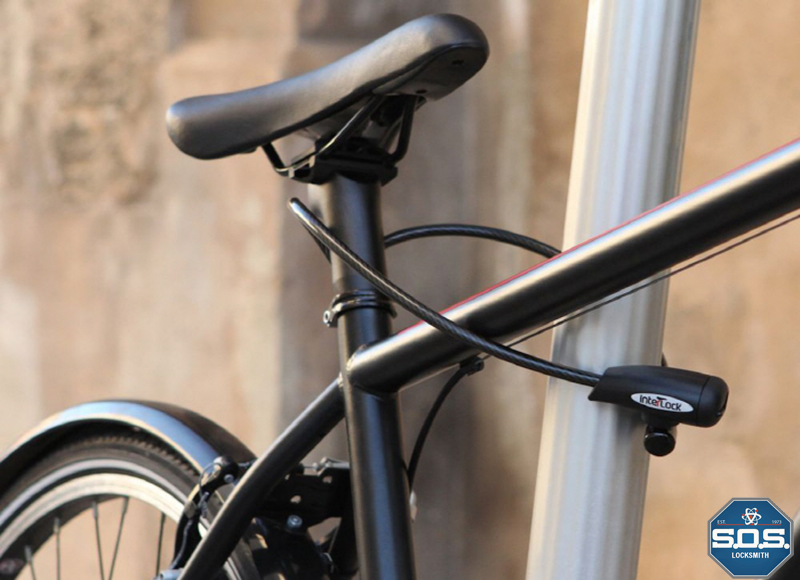
In this blog entry, we’ll discuss potential solutions to the threat of bicycle theft. These solutions are a practice of a balance between practicality, cost, and convenience. Most people can’t carry around a heavy duty chain and eight locks wherever they go. However, with every compromise for convenience, you’re lowering your security. The more security levels there are for your bike, the less chances it’s going to get stolen – less thieves will even attempt the theft, and the one’s that do are less likely to succeed.

Bike-Theft Statistics

Riding on a bicycle is an integral part of many people’s leisure as well as their commute. It’s an exercise method, a transportation method, and a way to relax. One source of concern for cyclists is how to safely secure bicycles throughout the day – as bikes have become much more widely used, bike theft has also increased. According to the FBI, at least 190,703 bikes are stolen per year – and that statistic is a reflection of reported thefts. A study in Canada showed that 76% of bikes that are stolen are ones that cost under 500$. This demonstrates the fact that even cheaper bikes are at risk of theft – bike thefts aren’t usually premeditated`, but are rather acted on a spur-of-the-moment level.

U-Locks

Many bike owners really prefer using U-Locks to the typical padlock because it gets rid of the need to carry around a heavy change – which can be both cumbersome and dangerous. You’re going to need more than one U- Lock if you’re discarding the chain completely – if this is the case, carry as many U-Locks as possible, as it’ll only make your bike more secure. The best points to place the U-Lock is on the frame, the anchor point, and the wheel of the bike. Make sure that both sides of the U-Lock shackle release – if this doesn’t happen, a potential criminal would only need to cut one side in order to free the bike.

Padlocks

There’s a massive variety of padlocks available. You can find padlocks for a measly couple of dollars, and you can find padlocks that cost in the thousands. The criteria that you should focus on in your search are the lock’s weight, the thickness of the lock’s body as well as it’s shackle, and a shroud (a piece of metal that covers the sides of the shackle to make it less accessible to potential thieves.) Keep your eyes out for rounded areas on the shackle which indicates that the lock has internalized ball bearings, which prevent it from being “shimmed”, a special kind of lock picking that can be improvised with everyday objects. As a word of warning, try to avoid buying Master Lock products, as their cheap price point is contrasted by their weak and easily broken materials. Be aware that spending some money on a padlock can pay off in its security value.

TUBULAR LOCKS

Posted onJanuary 6, 2016byadmin
locks tumb

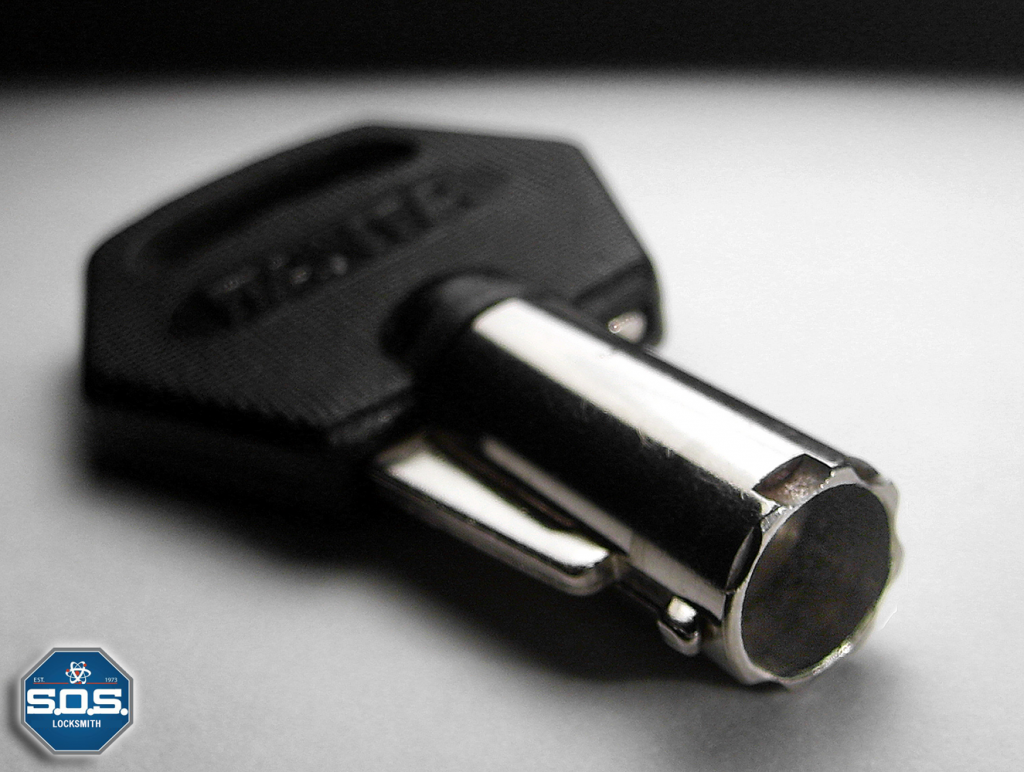
The device widely known as a tubular lock is also referred to as a circle pin tumbler, an Ace lock, or a radial lock. Similar to how tissues are ubiquitously/colloquially referred to as Kleenexes, tubular locks are sometimes called Ace locks due to Ace being the company that originally manufactured this type of lock. They can commonly be found on commercial / industrial tools that are standing unattended for long periods of time – think of vending machines, for example. Tubular locks are generally considered to be of a higher security level than tumbler and wafer locks – mostly because of their scarcity; thieves aren’t as likely to know how to pick or cut them. In this blog entry I’ll go over some of the details about the structure and function of tubular locks.

Tubular Lock Structure

Tubular locks are named so because the keyway is encased in a cylinder. The circular keyhole is joined to a tumbler system common to other kinds of locks, however it differs in that it’s key pins are pushed in along a horizontal axis, rather than vertically like other kinds of locks. The mechanism that holds the key pins in (the plug) is built into the same cylinder as the mechanism that holds the springs and drivers – (the bible.) The key is circular, with outside facing grooves – and it can only be inserted into lock from a particular configuration.

Pick-Proofing

For the most part, tubular locks are tougher to pick than other locks. This isn’t to say that it isn’t possible to pick it – and like all locks, the security level of the lock varies depending on its particular model, make, and brand. However, tubular locks typically take a much longer amount of time to pick than other locks – a valuable feature, as the longer it takes for thieves to pick a lock, the higher their chances of being caught and apprehended. This makes tubular locks a great preventative deterrent.

Technically, you can define tubular locks as being slightly different pin tumbler locks – they aren’t military grade security locks, but they work well and reliably. I mean to say that these locks – for the most part, the one’s common to consumers – aren’t fit to prove impervious to the advances of a highly seasoned lock-breaker; however, they certainly add a level of security to property that, combined with other measures, provide a solid line of defense against theft. If you’re interested in finding a tumbler lock right for you, I recommend searching online or through your local locksmith’s inventory for one with the features suitable to your specific security needs.

Mul-t-Lock Cliq Lock

Posted onFebruary 20, 2015byadmin
MUL-T-LOCKNYC

Securing your home or business is a top priority, and you may think that you need to invest in a comprehensive alarm system with high-tech features that can cost a small fortune in order to keep people and property safe and sound. While that is one option available to you, it is not the only one. Mul-T-Lock CLIQ LOCK is a revolutionary and innovative locking solution that can transform the way you secure your property.

What Is Mul-T-Lock CLIQ?

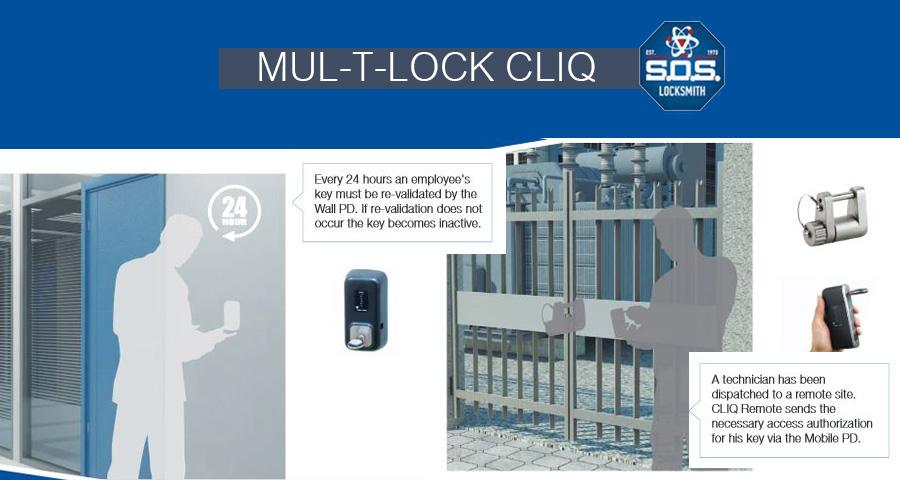
This is an advanced, patented electromagnetic locking system that does not require wires or an extensive installation process. The technology is built into your keys, padlocks and cylinders in the locks, and it essentially turns these devices into smart features that you have full control over. You simply have to install the special locks and hand out the keys to those who you want to give access to the property to. When you complete this step, you can begin taking advantage of the features and benefits in Mul-T-Lock CLIQ.

What Are the Features and Benefits?

These are highly intelligent products that give you better control over the security of your property. For example, you can control access to the property by enabling or disabling access during specific periods of time during the day or week. You can monitor who enters the property, and you can generate a full audit report of a person’s actions on the property. The technology is accessible through online controls, and this gives you control over property security and access from any location where you can use a mobile device. The system is completely scalable, making it suitable for larger and smaller venues alike. This makes it cost effective for almost every budget. For some, this is the only security feature that they will need on their property. Others may use this in addition to an alarm system for even more comprehensive benefits.

You may be concerned about the safety of your loved ones at home, the ability to control access to your workplace by workers or vendors and more. Regardless of what your current safety and security concerns are for any size property, you will find that Mul-T-Lock CLIQ is a great option for you to consider. You may take a closer look at how this product works and get a quote for the cost of the keys, locks and padlocks that you will need for your property today.

Build your CLIQ ® Solution

Every environment and organization is different. And within each environment there may be a wide range of access points to control with a variety of operational needs to consider. With CLIQ, you’ll be able to build an access control solution that effectively addresses your specific needs and is tailored to your location and operations. View which combination of CLIQ products makes up your ideal access control solution.

CLIQ Cylinders & Padlocks – based on Mul-T-Lock’s renowned High Security mechanical platforms, the electromechanical CLIQ Cylinders and Padlocks maintain authorization lists to ensure only enabled keys have access. Additionally, it collects and stores information for audit trail events. Available in a wide range of applications including Euro (double or single), Rim, Mortise, K.I.K, padlocks, switch cylinders and more, the CLIQ Cylinder can be deployed almost anywhere.

WatchLock ® CLIQ ® – combines multiple technologies – GPS, GSM, and patented mechanical and electromechanical platforms – to create an intelligent locking solution. It provides flexible access control over your assets and information about when and where your assets have been accessed. With audit trails available from both WatchLock and CLIQ, you’ll have accurate records about all assets under WatchLock CLIQ protection. Ideal for remote, hard to reach or mobile assets, this comprehensive solution gives you the control you want and the information you need to enhance the protection level of your assets and premises.

CLIQ User Keys – are electromechanical keys used with CLIQ cylinders. All keys feature LED indicators that signal for authorized and unauthorized access, out-of-schedule use and low battery notice. Select the CLIQ keys or a combination of them based on your needs.

CLIQ Quartz Key – can be programmed with specific time schedules, they also capture audit trail data of up to 130 events.

CLIQ QuartzXT Key – is used with CLIQ Remote and can store up to 1000 events for audit trails. The key can also be programmed with specific time schedules.

CLIQ Quartz+ Key – is used with CLIQ Remote and can store up to 1000 events for audit trail and be programmed with specific time schedules. In addition, the Quartz+ has an additional feature that allows system administrators to predefine a list of authorized cylinders that limits the Quartz+ key to open only those designated cylinders.

CLIQ Manager Software – installed on your local network, CLIQ Manager Software is used for the daily management of your CLIQ system. Designed for secure access, login to the software is fortified and only possible with the C-Key and authorized PIN code. With CLIQ Manager Software, system administrators can manage and create access permissions; audit trails; time-based authorizations; reports and much more.

CLIQ Web Manager Software – is an easy-to-use, web-based software program that allows system administrators to manage their CLIQ Remote platform from any computer, anywhere. In addition to daily functions such as managing and creating access permissions, audit trails, time-based scheduling and reports, the program also supports remote programming devise management; key programing and key and personnel management.

CLIQ Control Key (C-Key) – provides secure access for transferring information between the system’s software and its cylinders, such as updating key authorization lists within the cylinder and the retrieval of audit trail info from cylinder to software. Used for unlocking electronic communication and not actual access points, every CLIQ system has at least one C-Key referred to as the Master C-Key. Additional C-Keys can be added to the system.

CLIQ Local Programming Device (PD) – is used to connect CLIQ keys and cylinders to the system’s management software CLIQ Manager and/or CLIQ Web Manager. The PD provides secure communication that can update CLIQ keys with the latest authorizations and scheduling; retrieve and upload audit trails; and transfer tasks from the CLIQ software to your C-Keys (Control Keys).

CLIQ Wall Programming Device (WPD) – always online, the WPD has its own IP address that enables you to remotely program your CLIQ keys including making authorization and scheduling changes; retrieval of audit trails; revalidation of keys, sync of time settings; updating CLIQ keys’ firmware and more.

CLIQ Mobile Programming Device (MPD) – extremely efficient, the MPD allows you to program CLIQ keys on-the-go using a cellular phone or computer as a modem. With it, you can easily make authorization and profile changes; revalidate keys; retrieve audit trails; sync time settings and more – when and where you need to.

Securing your NYC Apartment

Posted onFebruary 16, 2015byadmin
nyc apartment security

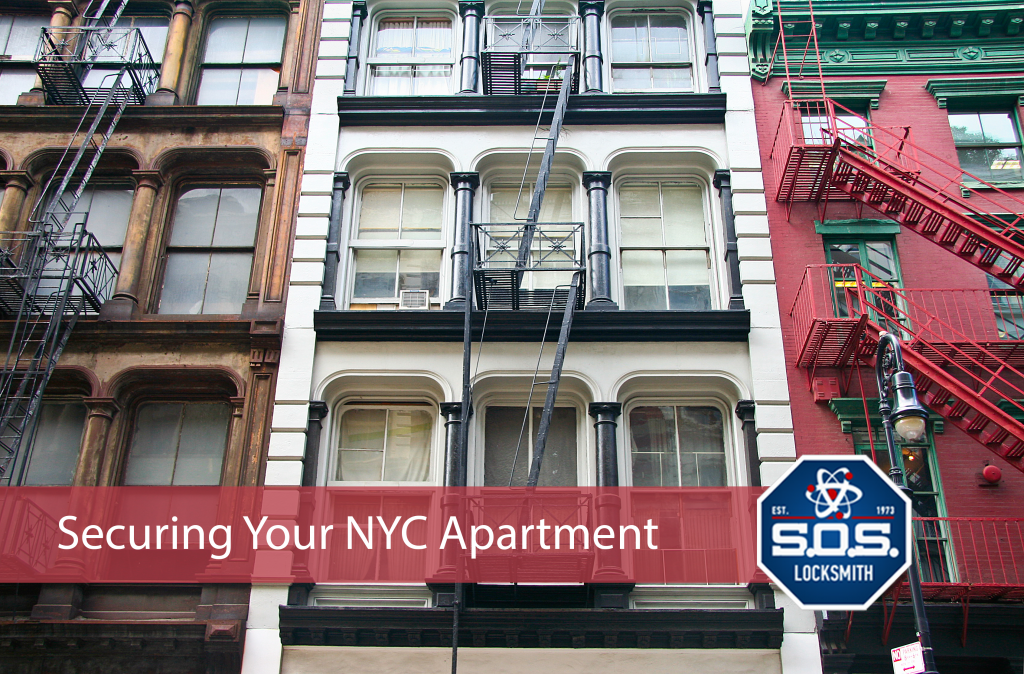
There are many different security options available to make sure that your apartment is safe whether you are at home or not. SOS LOCKSMITH has listed below ways on securing your NYC apartment. You can choose to have an alarm system , have upgraded door and window locks, or you can even buy a dog that will bark loudly when someone is trying to enter your property.

Upgraded Locks

There are many different security locks available on the market by Medeco Locks and Mul-t-Lock . A barrel bolt is another good lock choice. Combination locks and keyless entry locks are also smart choices. Use high quality Grade-1 or Grade-2 locks on exterior doors to resist twisting, prying, and lock-picking attempts. A quality deadbolt lock will have a beveled casing to inhibit the use of channel-lock pliers used to shear off lock cylinder pins. A quality door knob-in-lock set will have a ‘dead latch’ mechanism to prevent slipping the lock with a shim or credit card.

Use a solid core or metal door for all entrance points Use a quality, heavy-duty, deadbolt lock with a one-inch throw bolt Use a quality, heavy-duty, knob-in-lock set with a dead-latch mechanism Use a heavy-duty, four-screw, strike plate with 3-inch screws to penetrate into a wooden door frame

Alarm Systems

A good alarm system will monitor all of the entry points into your apartment. Your door should have an alarm on it as well as all of the windows in your unit. You may also want to have security cameras installed inside of your apartment. There is a new technology available that will allow you to view your home while you are not there through your smartphone or computer. You can check in on your apartment while you are at work or even while you are on vacation if you have a high tech security system.

Security Lighting

Security lighting is a basic security feature that can be very helpful. Many apartments offer exterior security lighting in parking lots and around the entry points to the building. Bright lighting can deter crime and help people feel safer.

Electronic Key Cards

Electronic card access is a popular choice. When people use electronic cards, they can have confidence that no one else has a key to their apartment since key cards can be changed with ease. New residents receive a new card that wipes out the old tenants’ access. Cards can be changed very quickly and with ease. Key cards can also be given for other parts of an apartment complex. They can give people access to certain parts of an apartment like common areas or exercise rooms.

Security Gates

Security gates can be a nice security option. Gates can help apartment owners feel comfortable. They allow only people that live there or have permission to be there to be on the property.

Home Safes

There are great prices on safes at SOS Locksmith , having a safe in your home is a wise investment. Home safes are designed to keep the smash and grab burglar, dishonest nanny, cook or housekeeper from gaining access to important documents and personal property. Home safes need to be anchored into the floor or permanent shelving. Here are few ways to make it work:

– Use the safe everyday so it becomes routine -Protect the safe code and change it occasionally -Install it away from the master bedroom or closet

If you want to live in a secure NYC apartment, find a complex that has good locks, lighting, and that is in a good location or get security consultation from NYC Locksmith You can enjoy feeling comfortable in your apartment at all hours. You want to stay in a building that makes you feel secure.

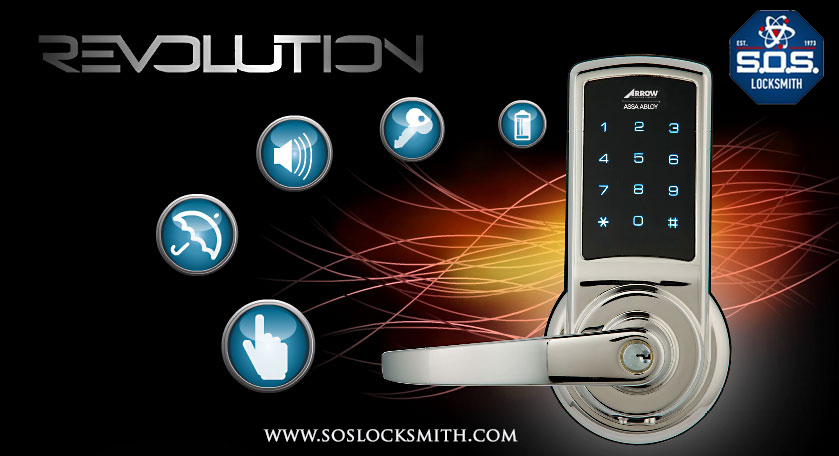
Arrow Revolution Locks

Posted onDecember 10, 2014byadmin
Arrow-Lock-Revolution

Arrow ’ s Interactive Revolution Locks Means Business

The latest fleet of locks by the esteemed Arrow group has caught our attention this week. They’re called the Arrow Revolution . But what makes these deadbolts revolutionary? With a market catering to a healthy intake of new high-tech locking devices we filter out the most unique locks; locks that set themselves apart from the rest, and in doing so these do actually revolutionize the market. The Arrow Revolution locks stand true to their name. So here’s a peek at what’s sure to impress where advanced security is needed.

Specifications

The Arrow Revolution locks have many notable specifications. The main specs are advanced voice-guided programming and of course a very usable touch screen. Did we say voice guided programming? Yes we did. No longer is a user required to know coding and difficult to comprehend instructions. Tell the lock what to program through state-of-the-art voice recognition software and the lock does it for you. Delete keys, add and delete user codes, change between a trio of languages effortlessly. It’s too simple to be true. No, this is real. The Arrow Revolution is incredibly user friendly.

Specification Overview:

• 25 unique user codes

• Easily add and delete users

• Voice-guided programming

• Trilingual (English, Spanish and French)

• 1 year battery life

Grade

The Arrow Revolution models boast their normal robust frames that conceal innovative technologies. Bump proof, weatherproof and the rest. These locks are BHMA Certified Grade 2 or higher. With this grade, even the lower security models.

Warranties

As of now. The Arrow Revolution locks have two very comprehensive warranties. The Revolution V1 LeverThe Revolution V1 has a three-year limited warranty that includes both electronic and mechanical components. This particular lock is also certified for legal warranty due to break-in; but, normal part wear, abuse preventable or not is not covered in its warranty. The Revolution V2 Deadbolt’s warranty is substantial as well. This lock boasts a lifetime mechanical and finish limited warranty and a one year electronic warranty.

Benefits to the Arrow Revolution locks

If easy programming coupled with the highest standards in security: What else could you possibly need? Well, There’s more. Beyond easy to use voice guided programming, Arrow brings manufacturers these locks in aesthetically gorgeous finishes that compliment the fave of its touchscreen technology. Keypads also mean no more dealing with keys, lost, stolen or at the bottom of your purse in the rain. This touch screen can be locked or unlocked from wherever you are and is equipped with a security override in case of an emergency.

We are not done yet. The push button benefits of this lock have proved to be more economically useful for both commercial and residential properties that have been outfitted with this technology.

If your commercial or residential property in NYC is looking for an upgrade in high-security locks, get an estimate at SOS Locksmith . The Arrow Revolution locks cover their bases and as per usual and in doing so extend a very beautiful fleet of new high-tech products to the advanced security market.

US Tennis Open Security

Posted onAugust 20, 2014byadmin
us open

This August’s US Open is set to take place in Flushing Meadows, Queens. While tennis fans have been anticipating the tournament for months, many of them, along with the event’s players have been put on edge as a result of recent terrorist attack rumors. There have been reports that the popular tennis tournament could possibly be the target of the infamous terrorist group Al Qaeda.

Many have criticized Inspire magazine for tipping malicious terrorist groups off as to where the best places would be to plant and explode a bomb. The New York City Police Department’s director of intelligence analysis, Rebecca Weiner, first reported that the magazine contained controversial material regarding the most efficient way to execute a terrorist attack on the tennis tournament. She recently revealed the information in a briefing for the city’s private security community. The magazine also lists Washington D.C. And Virginia as possible terrorist targets as well. Yet Weiner calmed some nerves by indicating that the NYPD does not know of any particular threats on the US Open.

Security At US Open in Flushing, NY

TimeLox has installed DC-One electronic door locks on each hospitality suite at the United States Tennis Association’s (USTA) Billie Jean King National Tennis Center (NTC) in Flushing, NY. DC-One is a dual-card (magnetic stripe and smartcard) system that allows hotels to enjoy the unique advantages that each technology offers, while maximizing security for both the property and guests. Combining the economy and reliability of magnetic cards with the flexibility of smartcard technology, DC-One not only makes hotel staff functions easier to perform, but also decreases the overall workload.

What US Open Attendees Need to Know

Tournament goers should be aware that US Open officials take security very seriously. They take significant and extensive steps to maximize the safety of the facility, the fans and the players. Everyone who enters the tournament site through the USTA Billie Jean King National Tennis Center entryways should show up before play actually begins as there could be some delays.

Every fan will be thoroughly screened before being allowed to pass through these entry gates. Tournament goers can only bring a single bag into the tournament stands. These bags can be searched by US Open security staff and city police officers at any time during the tournament. The bags must be smaller than 12 inches in width, 12 inches in height an 16 inches in length. The bags can’t be stored anywhere on the facility’s grounds. Fans will only be able to access a special bag storage space that is located outside of the stadium if they are willing to pay a fee.

Tournament officials recommend attending the event without a bag to expedite the entry process. There will be separate “speed line” entryways made available for fans who choose to attend the tournament without a bag.

There is a specific list of items that will not be allowed into the tournament. These include hard coolers or containers, noise making devices, alcohol, aerosol cans, backpacks, bottles, cans, anything made of glass or metal, sealed packages of any sort, video cameras or other recording devices, laptops, tablets or any other computers, food beyond very small quantities, pets, weapons, tennis racquets, laser pointers, signs, banners, flags and anything that constitutes an unapproved promotion or advertisement.

US Open security staff members are also allowed to bar fans from entering the facility with any other items that they consider to be dangerous or inappropriate. It is important to note that food required for babies or individuals with specific medical conditions will be allowed. While pets are not permitted, service animals will be allowed for disabled individuals.

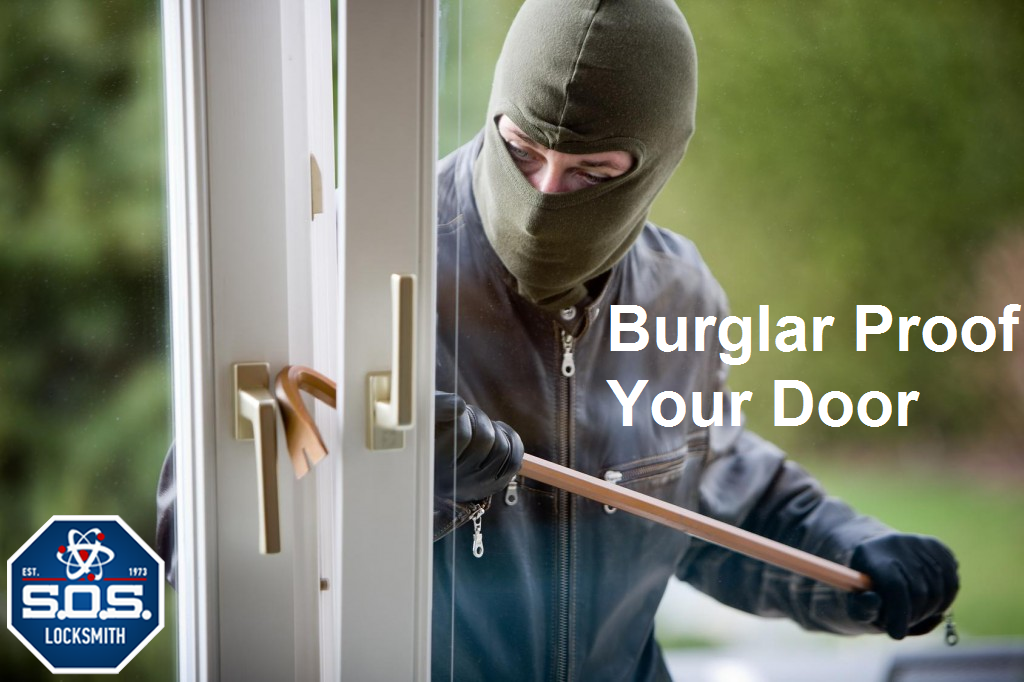
Burglar Proof Your Doors NYC

Posted onFebruary 27, 2014byadmin
burglar proof door

People do a lot of things to burglar-proof their home. Precautions readily exist. But, when it comes to actually securing one’s door, people take a costly shortcut when they shouldn’t. Securing a door isn’t that difficult, nor is it time consuming. In the end it’s probably easier than begging your neighbors to make snow tracks around your property to give the appearance of someone being home. We’ll let you know here how you can pull a few minutes aside to secure your door and feel safer when you’re home or away.

The Door Counts

Before we begin we need to ensure you have the right door. Having a pseudo-door, like one of cardboard or hollow build will not suffice in establishing your safety. Replace that door with one of the following.

Metal Door

Wood Door

Fiberglass Door

Windowed Doors

Windowed doors have an allotted entry to them. If you have a windowed door make certain that the build is reinforced well. If you have an alarm system, make certain that the door does not permit someone from the exterior to see if the house is set by an alarm system or not. Windowed doors do not maximize security as they are compromised by a slight design inclination.

Forget to lock up?

A significant amount of burglaries happen in one simple way. The burglar tests the doorknob and the door is not locked. Do not forget to lock your household when you leave. It sounds simple to those who are creatures of habit, but even those who are continually aware slip-up. It only takes one mistake to allow someone entry to your home. Additional attention doesn’t hurt your security.

Reinforce your door and entry

Bumping, picking and crowbar wrenching are common ways to break into a home, but all can be prevented with adjustments to your external locks. Try installing these few things to improve the security of your door.

Install Cylinder Guards

Replace Strike Plates

Try and secure exposed, corroded hinges

Re-sturdy and fortify your door frame

Viewer

Although it may seem a little funny, a viewer helps. What is a viewer? A viewer is a peep-hole, essentially. The main function of a viewer is to allow viewing from inside- out and not outside- in. Although this may seem petty, if one feels an extra eye on them from the door, they may feel more uncomfortable and not commit the burglary.

***

Besides for basic lock upgrades and installing CCTV cameras and light censors, easy burglar-proof door adjustments can go a long way in securing your home. Think these ideas over before leaving your home for long or short term times away.

Tips On Choosing Your Front Door

Posted onFebruary 20, 2014byadmin
nycfrontdoorLOCK

Choosing your entry door

The front door is the main entryway into your home. Some may argue that it is the most important for aesthetic value. But we disagree. We first and foremost want to consider its function and its security aspects. In choosing a front door you’re expressing what your entryway means to friends, family, neighbors, visitors and strangers. All things must be considered in depth before purchasing a front door. You may have already chosen the color you want for your new front door, but we’d like you to consider what kind of material you want that door to be. In the end that will create the biggest impression on your home, not the paint job.

Steel

Steel doors are common for entryways, but not all the time do they make the most sensible purchases. With steel doors it’s what is on the inside that counts. Steel and aluminum doors or combinations thereof -with a frame – can be especially sensitive to weather. In direct sunlight they can absorb and abundance of heat and in the cold they can allow a chill to permeate from their surface. Unless noted by the manufacturer (of an insulated construction) keeps steel doors in environments that are subject to Mediterranean-like temperatures. Take note that steal doors will also need periodic resealing and a good peal-free paint to boot.

Wood

Wood doors are also a pretty popular choice. Maybe more so than steel and aluminum doors, the inside matters most. We aren’t kidding. Wood doors specifically subjected to heat and weather will warp if not constructed properly or cared for. They require maintenance. If you’re not one for a little bit of door maintenance, stay out of the wood door market. Yet, wooden doors are superior at insulating a space. There are many ways to resist wood shrinkage and warping, but be aware before you make this purchase. Granted, wood doors are really, really lovely to look at when constructed well…

Fiberglass and Composite

Fiberglass and composite doors are the crème de la crème of entryway doors. They require almost no maintenance and can appear like a wood door and function with nearly the same amount of insulation. Like anything else, they will be subject to periodic resealing, but can procure you with the biggest warranty over the other doors. That, however, comes at an expense. Fiberglass and composite doors tend to soak up the most banks in an initial cost.

Finishing ’ s

Although these doors may require a little different attention from one to the other, they all require a good finish or paint to maintain their lifespan. After purchasing the door that best suits you, make sure you give it the right protective layers so that it can serve you best over the longest amount of time. Here are a few things to take a look at:

Stain-and-clear finish

Paint Finish

High-Exposure Finishing

Paint finish/extras/ jamb caulking needed

DIY Door Installation

Posted onJanuary 28, 2014byadmin
Doors

Homes have what we call curb-appeal… From the street, if someone sees your front door and it appears that they could kick through it easily then it can put you at a great security risk as well. To prevent this one eyesore and that other little threat, we have a walk through on how to install your own front door and what to do about hiring someone if you don’t want to do it yourself.

Installing a door

First of all, don’t purchase a door if installation requirements, including tools to use, sizes and instructions don’t come with your purchase. It’s important that before installing a door you know what to use. And, more importantly, you need to follow any building regulations and have a new door on hand before you remove the old one. There are a ton of doors to choose from:

ALUMINUM DOORS

FIRE RATED DOORS

CUSTOM GLASS DOORS

WOOD DOORS

IRON DOORS

Measure

To install your new door, measure the height and the width of your door. Your new door should be 1/2 an inch less than the height and 3/4 of an inch less than the width of the opening.

Note: Make certain that you chose a door that opens with either your right or left hand as this is imperative to some entryways.

Removal

First off, remove any exterior trim or installation that helped secure the old door, if needed. This is useful if your new door comes with a new frame (pre-hung). Many indeed do. If uncertain, call the store from which you purchased the door and ask them for professional advice. Then, remove the old door from the hinges with a hammer and screw driver. Then, take the hinges off the jam as your new door should be equipped with new ones. Afterwards, remove the screws in the jam and sill. With a reciprocating saw cut away the door frame and remove. A pry bar can be done useful here also. When the removal is done, dry-fit the door before securing it into its place. Make certain that during this time the door doesn’t fall over.

Installation

The sub sill is where the door will fit into place. Make certain that its square and settle. A leveler can be used to make sure it’s sitting well. If not, make an adjustment with shims and make sure the new door clears the thinnest flooring. Do this by measuring from the bottom of the sill to the bottom of the door and check it against your flooring. If for some reason the new door will not clear, you can raise the door with additional sill pieces available for purchase at most home improvement stores.

Don ’ t forget to: Weather bead the sub sill with caulk. In the winter and through the seasons you’ll be happy you prevented any leaks of air or water from coming through. Also, apply caulking to the sill.

Setting the door in place and final installation

With the assistance of another individual secure the door in place from the bottom upwards. You can use shims to help stabilize the door while you do the remainder of the installation. Next, insert the shims at the hinge locations. This will keep the door fairly leveled and plumed. Then, you can drive the screws through the shims. At the door reveal make certain that there is an even gap. If it’s off center that will inhibit the door from closing properly. Check outside as well that the door and the jam stops are equidistant from top-middle-to-bottom. Lastly, place shims where the lock and deadbolt will be inserted. To ensure your door is going to work properly open and close it a few times. The manufacturer’s instructions may require further securing, check them and then proceed to the next steps. Any gaps should be sprayed with a minimal spray foam installation. When the insulation dries, remove the excess with a putty knife or something similar used for safe scraping. DO NOT A KITCHEN KNIFE.

Warning: This material is somewhat toxic; prevent any skin, eye, contact when applying.

Take the door out to paint and install the hardware

If necessary, place the door on sawhorses for these next steps. Use this time to paint the door or finish any caulking that you may have forgotten. Pre-hung doors are fairly easy to install in this scenario. Next install your hardware and you’re ready to open and close a new chapter within your home installation experiences.

Hire a specialist

No question it’s great to do it yourself, but for those of us who’d rather not spare the energy and peace of mind, our specialists can assist. Hiring a specialist is easy for you and will not break the bank. Not only that, then you can rest assured that the job is perfectly done to suit your needs. Installing a door is difficult for first timers, but we believe you can do it with a little time and patience. If you an unsure of what you want to do, you can always contact your local locksmith to request for a free estimate ! Whatever you choose we welcome you to your new door soon.